

Michael King
4th Warrant This Year - and it's only February

The Warrant
The paper is ordinary - letter-sized, black ink, fancy seal at the top, the blunt geometry of bureaucracy - but it carries with it the weight of an ending. It, in fact, ends with the trademark ink of Ron DeSantis’ blue Sharpie pen.
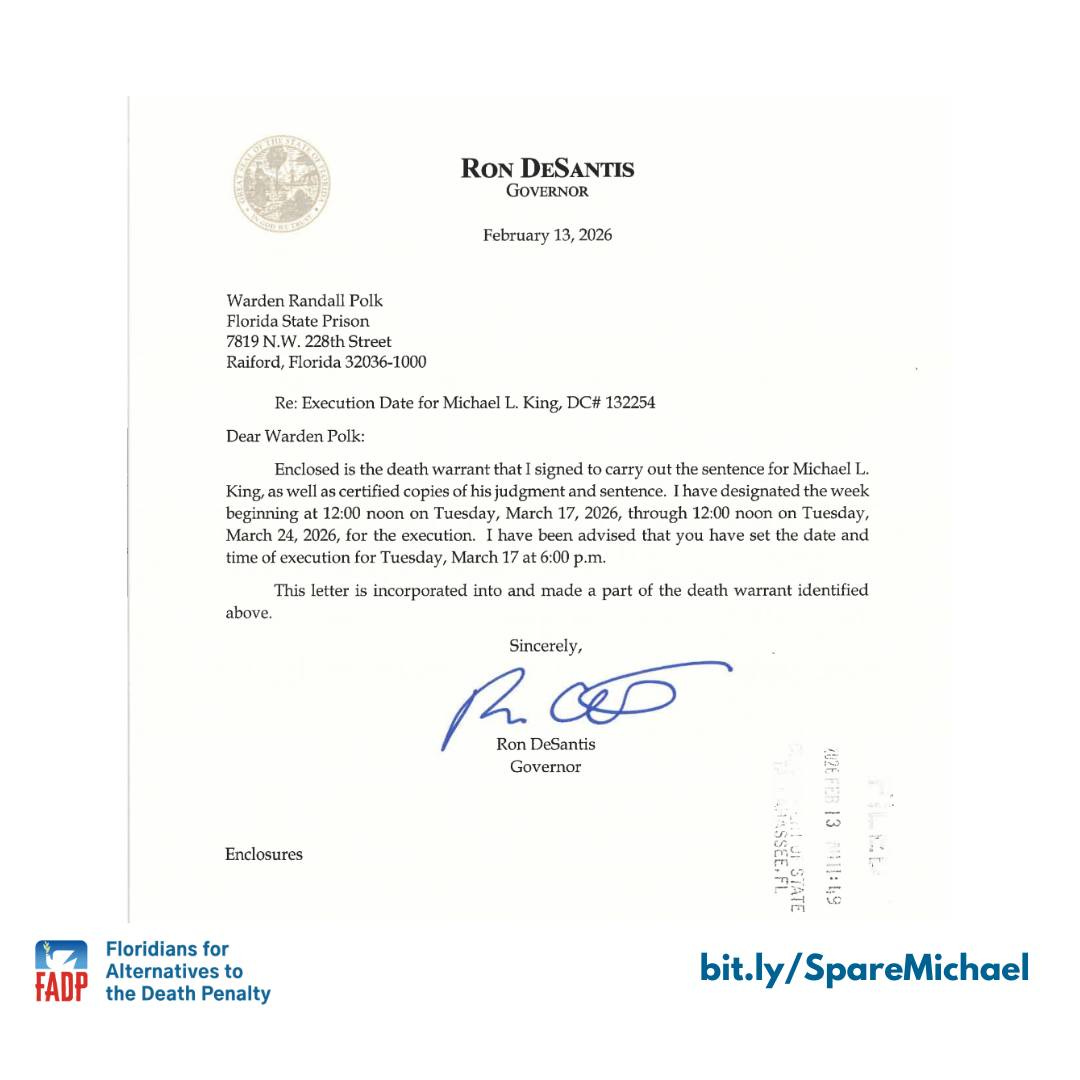
On Friday, February 13th, 2026, Florida Governor Ron DeSantis signed a death warrant for Michael King, a man whose name has traveled for years through court dockets, prison logs, and the quiet rituals of legal procedure. Now it has moved into a different category: a deadline.
In Tallahassee, the warrant is an administrative act, one more signature in a day of signatures. In North Port, Florida, where the crime that put King on Death Row first tore through ordinary life, it lands like weather: expected, dreaded, argued about, and impossible to ignore. For the victim’s family, it can feel like the calendar itself has turned into a corridor that must be navigated with caution.
For King’s lawyers, it becomes a race against dates - motions, stays, filings that must fit into ever-narrowing margins. For prison staff, it’s preparation - with checklists and rehearsals. For King, it is time reduced to a window, constantly narrowing until only a faint sliver remains.


Florida’s death warrants don’t just set an execution date; they set the tone. The state is not asking whether the punishment is permitted or even legitimate anymore. The machinery of death has already answered that question in a series of earlier rooms: the trial, the penalty phase, direct appeal, postconviction review, federal habeas, Supreme Court briefing schedules. The warrant is the door that closes.
And yet - right up until it does - Florida law still makes room for the last-minute argument:
[PENDING CLAIMS: e.g., mental health, intellectual disability, innocence, juror issue, ineffective assistance, newly discovered evidence, method-of-execution challenge]. This is the paradox at the center of capital punishment: finality pursued through endless procedure, a system that insists it must be exact while also insisting it must be done. Florida has adopted the “I-could-really-care-less” attitude of responses.
The Case That Became a File
Michael King’s story in the public record begins the way capital cases often do: with the starkness of the initial crime narrative, the first headlines heavy with certainty.
Florida man who sexually abused, killed North Port mother…GULF COAST NEWS
Michael L. King, Sexual Offender and Predator…FDLE
Denise Amber Lee shot and tossed in shallow grave…Sarasota Herald Tribune
The state said that on January 17, 2008, in North Port, Florida, King viciously abducted his victim, assaulted and raped her. When King was momentarily distracted she managed to get his cellphone and called 911. At least 4 others called 911, with one caller even following them for some 9 minutes and providing his exact location and description of the vehicle they were in. No officers were sent to investigate or assist.
King later drove her to a remote area, where he shot her and buried her.
The victim was Denise Amber Lee, the 21-year-old mother of two, daughter of a Charlotte County Sheriff’s sergeant, remembered in later testimony as a loving mother and wife. Investigators focused on mishandled 911 calls, DNA and forensic evidence gathered from the shallow grave and personal possessions of Lee, including a heart-shaped ring given to her by her husband which she had never removed from her hand.
At trial, the courtroom did what courtrooms always do: it converted grief into exhibits and turned a human life into a sequence of questions and stumbling answers. Jurors heard about the vicious nature of the abduction, the brutality of the rape and the cruelty of shooting Denise in the face. The defense presented little evidence, seeking to provide a reasonable doubt that King had committed the crime - tainting of evidence and contamination, even suggesting to the jury that one of King’s friends had committed the murder.
King’s defense failed to present evidence of his traumatic brain injury and exposure to toxins that were contributing factors to his borderline intellectual functioning. The defense asked the jury to widen the lens beyond the crime scene.
The verdict - GUILTY in 2 hours and 5 minutes. The sentence - death - recommended on September 4, 2009.
After that, the case began to change form. It stopped being “news” and became “the record.” It became citations and claim numbers. It became a paper trail, “Tr. p 27, L 31.” It became the kind of story that only resurfaces when someone dies, or when the state schedules death, or perhaps years later when the paper has long become moldy or transferred to digital records.
The Long Middle: Appeals, Motions, Silence
The public often imagines Death Row as a straight hallway leading to a locked door. In reality it’s a maze of waiting rooms.
King’s convictions and sentence moved through the Florida Supreme Court and into postconviction proceedings. The arguments - technical on the surface - carried the same underlying stakes: whether the trial was fair enough to justify an irreversible punishment, whether adequate evidence had been entered, whether defense counsel had erred.
Courts responded in the language of standards: “prejudice,” “harmless error,” “procedural default,” “credibility determinations.” Even when a judge is describing a murder, the tone is measured, almost antiseptic. That’s how law digests horror: by rendering it into testable and digestable parts.
While lawyers argued in documents, life outside the courthouse moved on. Witnesses aged. Family members relocated or died. Memories softened around the edges. But the case stayed pinned in place by its own gravity.
The legacy of Denise Amber Lee is that the Florida legislature unanimously passed what is known as the Denise Amber Lee Act which provides for training for 911 operators. Further improvements to 911 systems around the country are pursued by the Denise Amber Lee Foundation.
And then, with the warrant, all of that time collapses.
The State’s Moment
A death warrant does not arrive in a vacuum. It arrives in a political climate.
Florida has been unusually active in the modern death-penalty landscape, with shifts in jury requirements [Florida has the lowest bar in the country with only 8 jurors required to sentence a person to death], protocols and procedures [which are, even now, under scrutiny for the state’s own failure to abide by], executions carried out under a cloak of secrecy, and a governor who has been more than willing and almost eager to sign warrants and to set execution schedules. Supporters describe it as accountability. DeSantis claims that it provides “closure” and “justice” for survivors and families. Opponents describe it as hasty and reckless acceleration - state power moving faster than human certainty, and political posturing.
The warrant for Michael King is, in one sense, just one case among many. In another, it’s a public declaration: Florida is ready to accelerate and finish what it started.
The Human End of the Warrant
What gets lost in capital punishment debates is how many people are forced to live in the orbit of a single signature.
There is the victim’s family - years of anniversaries with a case number stitched into them, the hope that the system would one day stop calling. There is King’s family - if they remain in contact - facing a kind of grief that is socially unshareable. There are lawyers - some convinced of error, some convinced only that the process must be honest, all aware that the ticking of the clock is real. There are prison employees who will be asked to turn a living person into a completed protocol, over and over again. Florida is rushing ahead on a breakneck pace to surpass even 2025’s record of 19 executions.
And there is King himself, whose public identity is mostly the crime itself. He has become, in the end, what is embodied in the worst moments of his life. In the record, he is “the defendant.” In the warrant, he is “condemned.” In the hours leading to an execution, a person becomes mostly a schedule.
If you want to understand the story potential here, it isn’t just the crime or the politics. It’s the collision between time and certainty - how the state converts a moral decision into a logistical event.
It’s the logistics that we must overcome. It is time to abolish the death penalty.
To help to support my work, you can also buy me a coffee! Just click HERE or click the image below!

To join in the effort to help end Florida’s death penalty, click the image below!

Wonderful writing. Captures the real irrationality of dp.
So tragic in so many ways, Bill.